
How to Play
How we play the 5-1
If you've joined this league then you should know something beyond the basics of volleyball. Of course, some people have the basic skills but very little understanding of how to play 'competitive style' volleyball. Here are some introductory tips for competitive volleyball.
Absolute basics
Court basics
- The court is divided into six numbered zones.
- The player who serves is in zone one (back right when facing the net).
- The remaining zones on the court are labeled based on the order in which the players will be serving (counter clockwise).
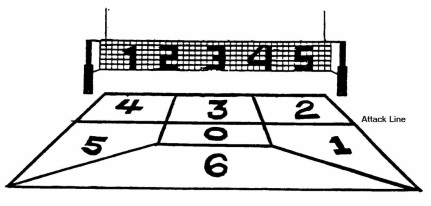
The picture illustrates the court zones while highlighting the basic defensive positions.
Basic court positions
At the most basic level there are only 3 court positions: left, middle and right. There are two players of each position that are opposite to each other in the lineup.
At the more intermediate level, players will usually play in one of the specific court positions based on their skill set.
Left players are also called: outside hitter, power hitters, wing spiker, left side hitter. We call them left sides.
Middle players are also called: middle blockers, middle hitters. We call them middles.
Right players are also called: opposites, weak side hitters, offsides, right side spikers. We call them right sides.
Setters can technically play in and from any position on the court but in our league most commonly play as right side players. A setter will spend most of their time on the court playing defense but because of their skill in setting the attack they will most frequently make the second ball contact before returning to their defensive responsibilities.
At the more advanced level, where our league plays:
- there may be only one setter on the court (5-1)
- players usually play in their position in the front and back court
Serve receive basics
Serve receive is anything but easy, but there are a few things to keep in mind.
- you can volley or forearm pass
- you can move forward or backward depending on the serve type
- call the ball
- move away from the ball if it's clearly not yours, this can make things more simple.
As a team:
- serve receive is a team thing, look where you are standing in relation to your team members to have the best result.
- 3 primary passers is the best way to go
- remaining players help cover difficult serves or stack with the setter (you'll see).
Switching positions
When your team is serving, the front row players:
- switch as soon as the serve is made
- position the middle player at the net in the center
- the player moving the furthest can be the furthest from the net
- the back court players do the same thing, just stay out of the servers' way
When your team is receiving serve:
- switch after the first attack (or when the ball goes deep over the net)
- switch quickly!
- always face the ball when switching
Defensive basics
The diagram above shows the basic defensive positions. For new players it should suffice to stay in your zone unless chasing an errant ball contact. As you become familiar, you will learn how to move on the court as a team (covering the '0' location in the diagram).
- if you're not blocking, get as low to the ground as you can (while still being able to spring upwards).
Offensive basics
Passers try to pass the ball high to position 2.5. Find position 2.5 between 3 & 2 on the floor.
- the setter sets the ball from 2.5 because it leaves more right-handed players on their strong side.
- hitting the ball when it is coming over your head makes it harder to see the court.
By default the setter should try to achieve the following:
- high set to the player in position 4
- a set 1-2 meters high for the player in position 3 (within 3 feet of the setter)
- a set 3-4 meters high for the player in position 2 (when the setter is in the back court).
As a hitter:
- move back from the net (attack line) before the set
- watch where the set goes before leaving the attack line (left & right players)
- start moving when the ball enters the setter's hands (as a middle hitter)
- when the setter is in trouble be non-committal and ready for anything; but respect your zone and let backcourt players attack as well (i.e. get out of the way).
Setting basics
- face where you're setting (unless in trouble)
- get to 2.5 fast!
- don't 'bump' set unless you have to
- remember that you're playing defense most of the time (especially when in the back court)
- you don't have to be the hero: stop chasing after bad passes that are beyond another player on the court
- remember that on a missed pass you can become an attacker.
- get close to the net before the pass is made and don't step away from the net until you analyze where the ball is going.